Going below the map to find Paris’s other population
I went to Paris to look at the data. Most people go for the art, the food or the pleasure of sitting outside a café without needing to explain themselves. I went underground to look at several million dead people.
Above ground, Paris is aggressively alive, measured through population, movement, work and tourism. Below is another population: millions of former Parisians moved from overcrowded cemeteries into abandoned quarries. They are no longer individually countable, but the space they occupy and the visitors around them are recorded with impressive care. Death, it turns out, comes with quite a lot of management information.
The map shows two systems occupying the same space. Above ground, regular streets and buildings organise movement, housing and connection. Below, limestone passages branch and bend according to geology and quarrying. One map shows where people needed to go; the other, where the stone happened to be.

The city above
Paris above in numbers
- 2,103,778 residents: the 2023 municipal population recorded by Insee.
- 19,959.9 residents per square kilometre: the average population density in 2023.
- 1.15 to 1.61 million hotel arrivals: the monthly range recorded by Insee in 2023.
Sources: Insee population and density data; Insee hotel arrivals data.
At street level, Paris does not feel like a place waiting to be measured. It feels like a place trying to walk into you while you check a map. Yet every resident, commuter, student and visitor adds to a population that changes according to what is counted and when.
Movement leaves a statistical trail: journeys, roads, trains and pedestrians. Ordinary life becomes rows and columns, which is reassuring if, like me, you enjoy the illusion that a well-labelled spreadsheet can explain human behaviour. Above-ground data have verbs attached: living, moving, visiting and occasionally holding up the queue at a ticket machine.
The city below
Catacombs in numbers
- 11,000 square metres: the total area of the ossuary.
- 1.5 kilometres: the public route through only part of the underground quarry network.
- 20 metres underground: roughly the height of a five-storey building.
- 243 steps: 131 down and 112 back up.
- 1785 to 1787: the period of the first transfers from the Saints-Innocents cemetery.
- 1859 to 1860: the period of the last major transfers during urban works.
- Nearly 550,000 visitors: the approximate annual audience for the population below.
Sources: Paris Catacombs, History; Paris Catacombs, Site history; Paris Catacombs, Geology and the quarries.
Long before the bones arrived, the tunnels had supplied the limestone used to build Paris. As the city spread over its abandoned workings, collapses became a serious problem, prompting Louis XVI to establish the Inspection Générale des Carrières in 1777 to map, monitor and reinforce them. The city was already resting on a hidden piece of infrastructure before it acquired its hidden population.
The descent provides enough time to reconsider both the visit and your cardiovascular fitness. At the bottom, an engineering solution to overcrowded cemeteries and unstable quarries becomes visible as walls of human remains.
The cemetery crisis was equally practical. The Saints-Innocents cemetery, used for nearly ten centuries, was closed in 1780 amid growing concerns about overcrowding and public health. Its graves, mass pits and charnel houses were emptied between 1785 and 1787. To limit opposition from residents and the Church, carts carried the remains after nightfall to the disused Tombe-Issoire quarries, where they were tipped down service shafts and stacked by quarry workers. On 7 April 1786, the site was consecrated as the Paris Municipal Ossuary and adopted the more evocative name “Catacombs”, borrowed from ancient Rome.
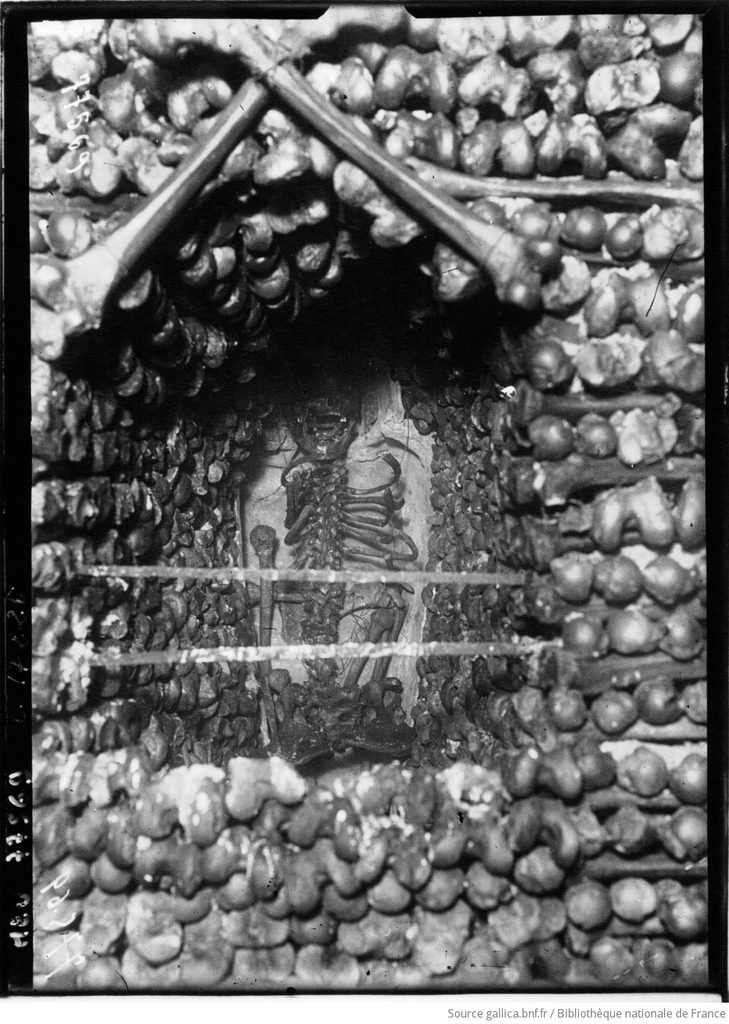
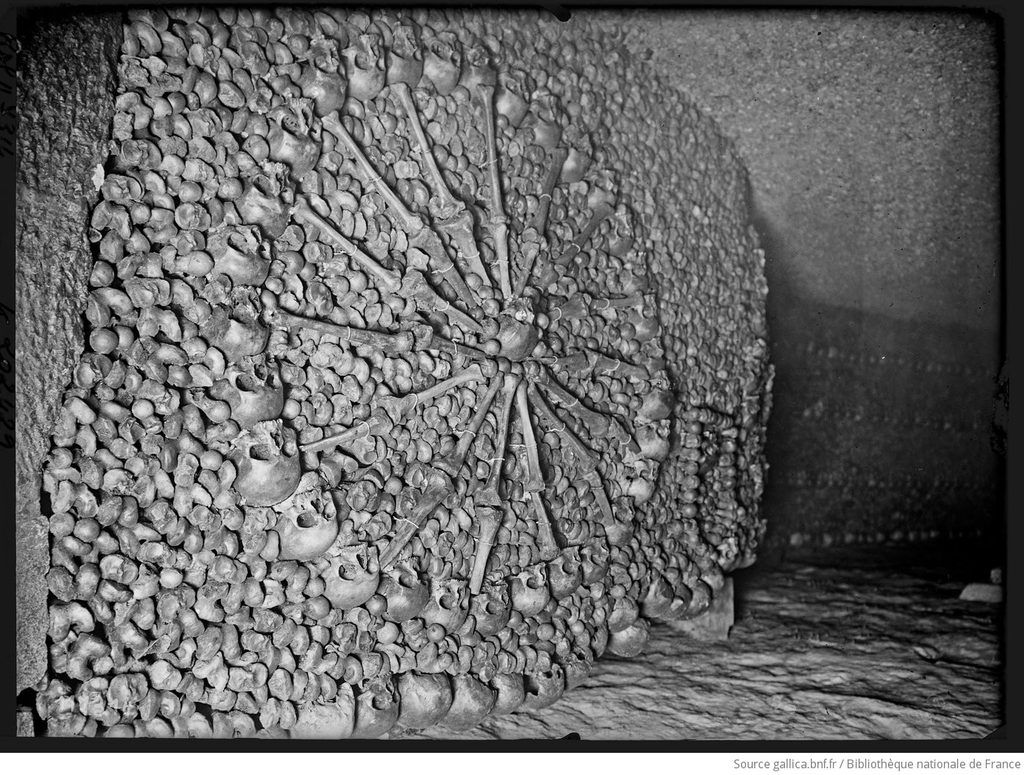
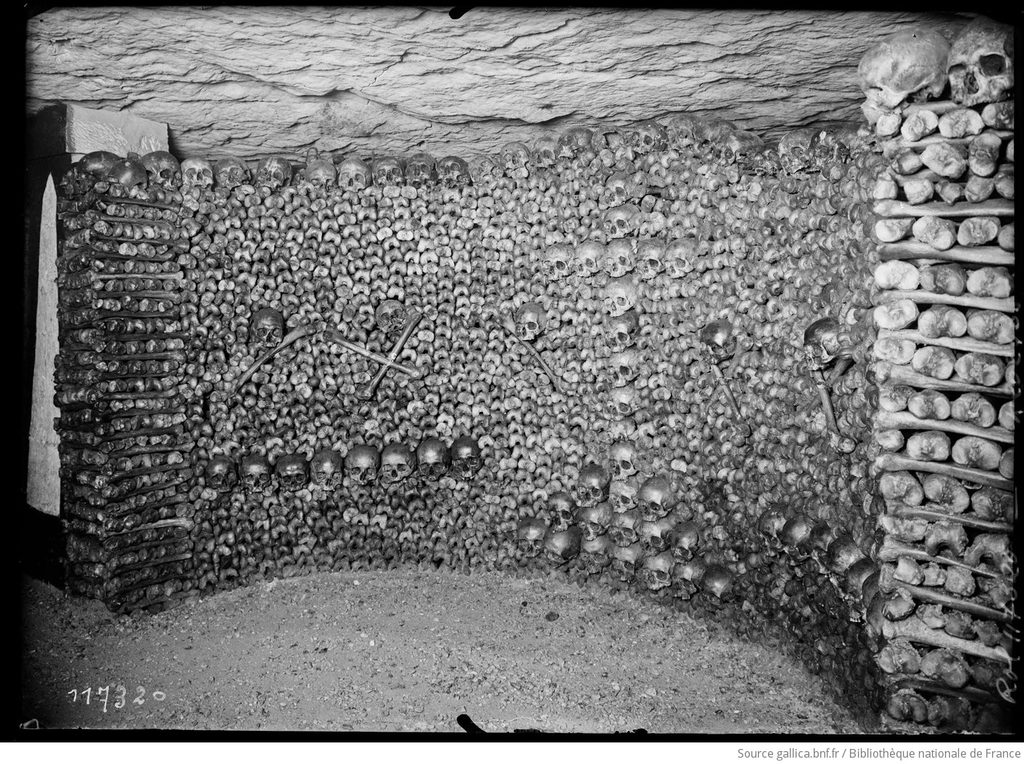
That visual order came later. After becoming Inspector General of Quarries in 1809, Louis-Étienne Héricart de Thury began transforming the ossuary from a store of loosely piled bones into a deliberately designed public space. Between 1810 and 1814, the remains were rearranged into the walls still seen today: rows of femurs and tibiae punctuated by skulls, with smaller fragments placed behind them. He also added plaques, inscriptions and monuments inspired by classical and Egyptian forms. The result was part engineering, part museum display and part memorial—and the reason an enormous heap became something that looks, unsettlingly, composed.

The population below is difficult to count, while the space around it is measured precisely. The public route reveals only a small part of both the ossuary and the wider quarry network. Even the dead, it seems, are subject to sampling.
“Even by Paris standards, 545 people per square metre feels crowded.”
As a deliberately rough thought experiment, dividing the estimate of more than six million remains by the ossuary’s recorded floor area gives about 545 people per square metre—around 27,000 times Paris’s residential population density. This is not a true like-for-like density measure: floor area is not land area, and the remains are neither whole bodies nor evenly distributed. It is better read as an illustration of compression than as demography. The population below is physically as well as statistically aggregated.
Two populations
Calling both groups a population feels accurate and slightly absurd. Above ground are people with addresses, jobs and journeys. Below are people reduced largely to an estimate and, sometimes, a plaque naming their cemetery. One population fills in forms; the other has become a rounding problem.
“For every living Parisian above ground, there are roughly three dead Parisians below it.”
Insee—France’s counterpart to the ONS—provides the regularly updated census count for the living population, while the population below is a historical estimate. The contrast is therefore not only between living and dead, but between two very different kinds of data.
Source note: The text on the 1857 map states, “The number of bodies whose remains are housed in the Catacombs is estimated at three million.” The official Paris Catacombs website now describes the ossuary as containing the remains of “several million Parisians”. The figure of more than six million is a widely cited estimate rather than a precise count.
Living Parisians can be counted as residents, workers, passengers or visitors. Underground, these distinctions have collapsed. The ordered walls tell us something about cemeteries and transfer dates, but rarely who is in front of us. Aggregation makes the scale visible while smoothing away the lives inside it.
Above ground, people are individually visible but represented as totals. Below, their remains are visible while the individuals are mostly unknowable. The city above produces data because people keep doing things; the city below has become data because so much else has been lost.
Death as a destination
Since opening to the public in 1809, the ossuary has become a museum, a heritage site and an item on a weekend itinerary. Nothing says spontaneous city break quite like booking a timed slot to inspect the former residents.
The Catacombs are often labelled dark tourism, but I am unconvinced that engaging with death is inherently morbid. As a goth, I may not be neutral, but death is part of life whether we look at it or not. The Catacombs let us acknowledge it rather than keeping it politely out of sight and allowing fear to fill the gap.
The living population passing through is managed precisely: timed tickets, a one-way route, limited numbers and measured bags. Remains once moved out of sight are now the reason people arrive. The visit can be educational and commercial at once, though not entirely comfortably; we learn about public health and quarrying, then emerge through a gift shop.
What the numbers miss
Several million is an effective number: large enough to convey scale and impossible enough to discourage a recount. It tells us almost nothing about who those people were. Plaques preserve cemeteries and transfer dates, but names, occupations and relationships have mostly disappeared. It is provenance at population level.
In my work at the ONS, I have used aggregation and disclosure control to reveal useful patterns without exposing the people behind them. It is a careful balance between showing enough and protecting enough. The Catacombs invert that process: the people have been grouped so completely that their identities are not protected but lost. In both cases, a population becomes visible while its members become harder to see—but for very different reasons.
The bone walls make aggregation visible. Repeated femurs, tibiae and skulls create patterns that are precise and extraordinarily beautiful. I responded as I might to a striking data visualisation: seeing the overall structure, then remembering what each mark represents. Here the marks are human remains, which makes admiration more complicated, not less valid.
“A population should never become only a number, even when the number is the clearest thing left.”
Below the map
he map shows two ways of seeing a population. Above ground, data capture what people do. Below, the total survives while individual detail has disappeared. The people are anonymous yet unusually visible: we know less about who they were, but we see more evidence that they existed.
Perhaps that physical presence matters to me because I have never quite understood the appeal of cremation. These bones have been moved, mixed and anonymised, but kept. Cremation deliberately destroys the body as a recognisable form, and I still cannot quite get my head around that choice. Neither preserves the person, but the Catacombs make absence tangible.
Source: gallica.bnf.fr / Bibliothèque nationale de France.
Looking at death is not the same as treating it lightly. The scale is shocking, the lost identities sobering and the arrangement undeniably beautiful. Going below the map changed how I saw Paris above it: a living city resting over another population that remains present even when counting is the least interesting thing about them.
The map now hangs in my office as a daily reminder to look beneath the surface—and to keep asking what a map shows, what it hides and who might be missing.
Leave a Reply